
Introduction: Flooring Choices Matter in Religious Education
Choosing the right flooring for religious schools is far more than a design decision. These institutions function as educational centers, prayer spaces, community hubs, and sometimes residential facilities—all within the same environment. Floors are used intensively from early morning until evening, often by students who sit, study, pray, and walk barefoot on carpets multiple times a day.
In such conditions, the carpet must meet several simultaneous requirements: durability, hygiene, comfort, cultural appropriateness, and cost-efficiency. In recent years, acrylic carpets have become one of the most widely used flooring solutions in religious schools, particularly in Islamic education centers across the Middle East, Africa, and parts of Asia. This article explores whether acrylic carpet is truly suitable—and why it is increasingly preferred by institutions worldwide.
The Specific Needs of Religious School Environments
Religious schools differ significantly from standard educational buildings. Their carpets are not just walked on; they are actively used for:
- Daily prayers
- Quran recitation sessions
- Sitting on the floor for long study hours
- Large group gatherings and lectures
- Seasonal events with very high attendance
Because of this multifunctional use, carpets must withstand constant pressure, repeated cleaning, and direct skin contact. Additionally, religious institutions often follow strict cleanliness standards rooted in spiritual practice, making hygiene a top priority.
Acrylic carpets are engineered to perform well under exactly these conditions, combining structural strength with hygienic properties that support both physical comfort and religious requirements.
What Makes Acrylic Carpets a Practical Choice for Religious Schools?
Acrylic is a synthetic fiber designed to replicate the softness and warmth of wool while eliminating many of its weaknesses. Unlike natural fibers, acrylic does not easily absorb moisture, which significantly reduces the risk of mold, odor, and bacterial buildup—common problems in high-use carpeted environments.
According to The Carpet and Rug Handbook by John R. Howell, acrylic fibers are particularly well-suited for public and religious buildings because they offer thermal comfort, color stability, and resistance to biological contaminants. These characteristics make acrylic an excellent match for schools where students sit directly on the floor for extended periods.
From a practical standpoint, acrylic carpets provide a “best of both worlds” solution: they feel natural and warm, yet behave like a modern, engineered material.
Durability Under Daily and Repetitive Use
One of the biggest concerns for school administrators is longevity. Religious schools often host hundreds—or even thousands—of students each day. Classrooms and prayer halls see continuous movement, shifting furniture, and frequent cleaning.
High-quality acrylic carpets, particularly those produced in 700-reeds or 1000-reeds constructions, are designed to resist:
- Fiber crushing
- Surface matting
- Loss of texture over time
- Color fading due to repeated washing
Their resilience makes them a long-term investment rather than a short-term solution. When properly specified and installed, acrylic carpets can maintain their appearance and performance for 10 years or more, even in demanding school environments.
Hygiene and Health Advantages in Educational Religious Settings
Cleanliness is both a health requirement and a religious obligation in Islamic education environments. Carpets in madrasas and religious schools come into close contact with:
- Bare feet after ablution
- Foreheads during sujood
- Children who are more sensitive to allergens
Acrylic fibers naturally resist microbial growth and do not retain moisture like wool or cotton. This significantly reduces the presence of:
- Bacteria
- Dust mites
- Mold spores
- Persistent odors
For schools concerned with student health, especially in warm or humid climates, acrylic carpets provide a safer and more hygienic flooring option.
Ease of Cleaning and Maintenance
Maintenance efficiency is critical for institutions operating on fixed budgets. Acrylic carpets are particularly valued for how easy they are to clean.
They:
- Dry quickly after washing
- Retain color even with frequent cleaning
- Do not shrink or deform
- Tolerate regular vacuuming and shampooing
In religious schools where carpets may be cleaned weekly—or even daily during peak seasons—this ease of maintenance reduces labor costs and minimizes downtime of prayer and study areas.
Cultural Compatibility and Design Flexibility
Beyond performance, carpets in religious schools must visually align with Islamic values and architectural traditions. Acrylic carpets excel here because they can be woven with:
- Prayer lines for organized rows
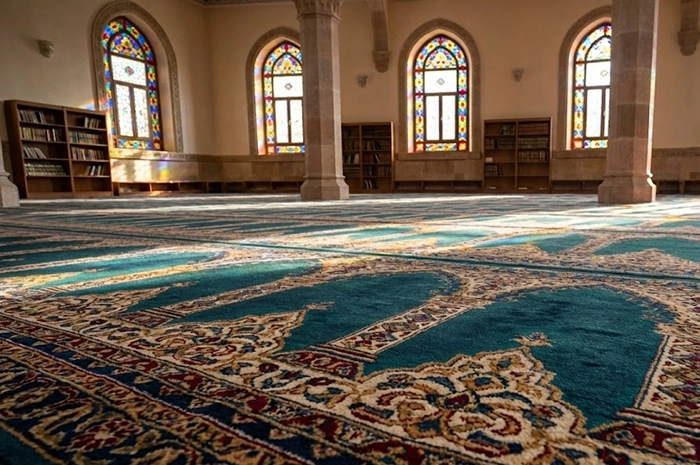
- Mihrab motifs for directional guidance
- Traditional Islamic geometry
- Calm, respectful color palettes (green, burgundy, blue, beige)
Iranian manufacturers like Pamchal Carpet specialize in producing acrylic carpets that respect cultural expectations while offering modern production precision. Custom widths, roll formats, and layout designs allow seamless installation in long corridors, classrooms, and multi-purpose prayer halls.
Cost-Efficiency for Institutional and Bulk Procurement
Budget constraints are a reality for most religious schools and non-profit institutions. Compared to wool carpets, acrylic carpets typically offer 60–70% cost savings while maintaining a similar visual and tactile experience.
For institutions purchasing carpets in bulk—whether for multiple branches, regional programs, or national education networks—this cost efficiency is decisive. Pamchal’s export-grade acrylic carpets are designed specifically for institutional buyers, offering scalable pricing without sacrificing quality or compliance standards.
Long-Term Value and Institutional Sustainability
When evaluating flooring for religious schools, the true cost is not the purchase price—it is the total cost over the carpet’s lifetime. Acrylic carpets consistently outperform many alternatives by:
- Lasting longer under daily use
- Requiring fewer repairs or replacements
- Reducing cleaning and maintenance expenses
- Maintaining hygienic conditions over time
This makes them a sustainable choice not only financially, but operationally.
Conclusion: A Smart, Spiritual, and Practical Flooring Solution
Acrylic carpets offer an ideal balance of durability, hygiene, comfort, cultural compatibility, and affordability for religious schools. They support the spiritual atmosphere of learning and worship while meeting the practical demands of high-traffic educational environments.
As noted by carpet expert Dr. Ali Farahani in Fiber Trends in Religious Architecture:
“Acrylic carpets successfully bridge tradition and technology in modern religious spaces.”
For religious schools seeking a flooring solution that respects sacred values while delivering long-term performance, acrylic carpets from experienced manufacturers like Pamchal represent a reliable and future-proof choice.